You Won’t Believe These Hidden Corners of Cesky Krumlov’s Architecture
Cesky Krumlov isn’t just a fairy-tale town frozen in time—its architecture tells stories most travelers never hear. Beyond the castle and crowded main square, quiet alleys whisper secrets of Gothic beams, Baroque facades, and forgotten courtyards. I wandered with no map, letting crumbling walls and hidden archways guide me. What I found wasn’t just beauty—it was intimacy. This is a side of Cesky Krumlov few see, where every stone feels personal, and every turn reveals a moment of quiet awe.
The Town That Time Forgot – A Living Architectural Museum
Cesky Krumlov stands as a rare testament to uninterrupted architectural evolution, earning its place as a UNESCO World Heritage site in 1992. With over 300 historically protected buildings, the town offers one of Europe’s most cohesive medieval urban landscapes. Nestled along a tight bend of the Vltava River, its skyline rises like a storybook illustration—red-tiled rooftops cascade down steep hills, church spires pierce the morning mist, and stone bridges link centuries-old districts. Unlike more commercialized historic towns, Cesky Krumlov has preserved its authenticity through relative isolation, avoiding large-scale industrialization and modern redevelopment.
The town’s architectural continuity spans more than five hundred years, from its Gothic origins in the 13th century through Renaissance embellishments and Baroque flourishes added during the 18th century. This layered history is not hidden behind renovations or reconstructions but proudly visible in the fabric of everyday streets. Walking through the historic center feels like moving through a living museum, where preservation is not a performance for tourists but a way of life. Local regulations ensure that any restoration respects original materials and design, meaning new paint matches historic hues and roof tiles are replaced with traditional clay.
Even the layout of the town reflects its medieval roots. The irregular street pattern—narrow, winding, and often cobblestone—was never designed for cars or crowds but for foot traffic and horse-drawn carts. This organic structure contributes to the town’s intimate scale, making every passage feel personal. The Vltava River wraps around the old town like a protective ribbon, enhancing the sense of seclusion. Few European towns have resisted the pressures of modernization so completely, and it is this unbroken lineage that gives Cesky Krumlov its quiet authority among architectural treasures.
Beyond the Castle: Discovering the Real Heart of the Town
While the towering Cesky Krumlov Castle complex dominates postcards and guidebooks, the true soul of the town lies in its quieter, residential corners. Just steps from the main square, away from the tour groups and souvenir stalls, lie rows of well-preserved burgher houses—modest yet elegant homes once occupied by merchants, artisans, and local officials. These buildings, though less grand than the castle, offer a more human-scale understanding of history. Their color-washed facades glow in soft ochre, pale blue, and warm rose, each shade a clue to the personality of the family who once lived there.
Look closely, and architectural details tell rich stories. Ornate doorframes carved with floral motifs or family crests suggest pride in craftsmanship. Wrought-iron signs—once used to identify shops before house numbers existed—still hang above many entrances, shaped like scissors, loaves of bread, or wine barrels. Some buildings reveal medieval cellars beneath street level, accessible through stone staircases tucked beside alley walls. Others conceal arched gateways that once allowed passage between courtyards, now often blocked or repurposed but still visible in the masonry.
One of the most striking contrasts is between the vertical grandeur of the castle and the horizontal intimacy of the town’s streets. The castle looms from above, a fortress of power and privilege, while the burgher houses hug the ground, built for daily life. Their upper stories often overhang the street, supported by wooden beams that have settled with age, creating a canopy over the cobblestones. These homes were not designed for spectacle but for comfort, community, and resilience. In their worn stonework and uneven windows, visitors find a more relatable history—one of ordinary people living through extraordinary times.
Wandering the Labyrinth: Alleyways That Tell Stories
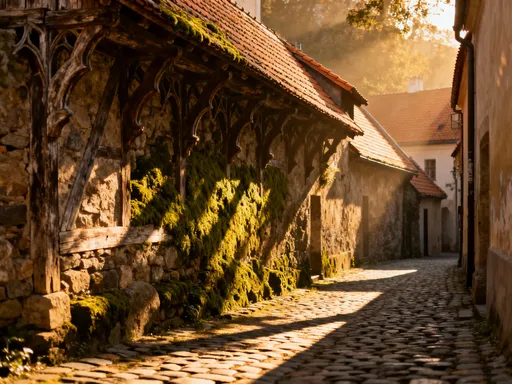
To walk Cesky Krumlov’s alleyways is to step into a three-dimensional narrative written in stone, wood, and shadow. Streets like Zámecká, Svornosti, and Skálova form a maze that defies logic, twisting back on themselves, narrowing into passages barely wide enough for two people to pass. These are not designed for efficiency but for centuries of organic growth, where each turn reveals a new layer of architectural surprise. A moss-covered wall gives way to a sudden courtyard; a low arch opens onto a view of the river; a crumbling gargoyle peers down from a rain-stained cornice.
The experience is as much sensory as visual. Footsteps echo against stone walls, their rhythm changing with the width of the passage. After a summer rain, the scent of damp limestone rises from the ground, mingling with the faint aroma of woodsmoke from nearby chimneys. Sunlight filters unevenly—bright in open spaces, then vanishing into tunnels formed by leaning rooflines. In some alleys, the upper floors of buildings lean toward each other so dramatically they appear to whisper secrets across the gap, their timber frames groaning softly in the wind.
These passageways were once functional arteries—used for deliveries, private access, and shelter from weather—but today they serve as quiet refuges from the main tourist routes. Few visitors venture far beyond the central square, meaning these alleys remain largely untouched by commercialization. A broken shutter, a patch of ivy growing through cracked plaster, or a cat sleeping on a sun-warmed windowsill—these small moments of stillness define the town’s character. There is no rush here, no need to check sights off a list. The architecture itself becomes the destination, revealing its secrets slowly, to those willing to wander without a plan.
Courtyards in Silence: The Hidden Interiors Most Miss
One of Cesky Krumlov’s best-kept secrets lies behind unmarked doors and narrow archways: the hidden courtyards tucked within the town’s historic buildings. These inner sanctuaries, often invisible from the street, were once the heart of domestic and social life. Accessed through dimly lit passages or beneath stone staircases, they open into sun-dappled oases of calm—flagstone patios, ivy-clad walls, and the occasional forgotten fountain, now dry but still elegant in its design. Some courtyards retain wooden galleries on upper floors, where residents once leaned out to greet neighbors or hang laundry.
Though many of these spaces remain private, a growing number of guesthouses, boutique hotels, and small cafes have begun to welcome respectful visitors. A polite inquiry at a family-run accommodation might earn an invitation to step inside a centuries-old courtyard, where the noise of the town fades and time seems to pause. These moments of access are not advertised, nor should they be; they are earned through curiosity and courtesy. One such courtyard, behind a quiet guesthouse on Latrán Street, features a 17th-century well and a grapevine that has grown along the same trellis for generations.
Historically, these courtyards served multiple purposes—laundry areas, storage spaces, and gathering places for families and servants. Their enclosed nature provided privacy and protection, especially during harsh winters. Today, they offer a different kind of value: solitude. In a world of crowded attractions and timed entries, Cesky Krumlov’s hidden courtyards remind us that beauty often resides in the overlooked. They are not grand or monumental, but their quiet dignity speaks volumes. To stand in one is to feel the weight of history not as spectacle, but as presence.
Gothic Bones, Baroque Skin: How Styles Blend in Plain Sight
One of the most fascinating aspects of Cesky Krumlov’s architecture is its visible layering of styles. Rarely does a building belong to a single period; instead, most are palimpsests of design, where Gothic foundations support Baroque facades, and Renaissance windows are framed by medieval stonework. This blending is not the result of haphazard renovation but of centuries of practical adaptation. As families updated their homes, they often preserved older structural elements while adding fashionable embellishments, creating a patchwork of beauty that rewards close observation.
Take, for example, a house on Svornosti Square with a clearly Gothic ground floor—thick stone walls, narrow pointed windows, and a vaulted cellar dating to the 13th century. By the 1700s, its owners added a Baroque stucco facade, complete with swirling motifs and a carved balcony. The contrast is striking yet harmonious, a dialogue between eras. In some cases, weathering has stripped away modern paint, revealing older brickwork beneath. Cracked plaster exposes timber framing that predates the house’s current appearance by centuries. These imperfections are not flaws but features, evidence of a philosophy that values continuity over perfection.
Preservation efforts in Cesky Krumlov actively encourage this respect for architectural layering. Rather than restoring buildings to a single historical moment, experts prioritize stabilizing existing structures while allowing their complex histories to remain visible. This approach differs from more sanitized restorations seen in other European towns, where the goal is often aesthetic unity. Here, the goal is authenticity. The result is a town that does not pretend to be frozen in time but instead acknowledges its long, evolving life. Every chipped stone, every mismatched window, every repurposed doorway contributes to a richer, more honest story.
Riverside Reflections: Architecture Meets Nature
Along the banks of the Vltava River, Cesky Krumlov’s architecture engages in a quiet dance with nature. Houses cling to steep slopes, their foundations supported by wooden pilings driven deep into the riverbank. Some buildings have cellars that sit at water level, designed to withstand seasonal flooding—a practical adaptation to the river’s rhythms. From certain angles, especially at dawn or dusk, the town appears to float, its reflection shimmering in the slow-moving current. The water doubles the beauty of the facades, creating a mirror image that blurs the line between reality and illusion.
Walking along the riverpath downstream from the main bridge offers some of the most breathtaking views with none of the crowds. Here, the town unfolds in profile—rooftops stacked like tiles, church towers rising above treetops, and laundry hanging from upper windows. The sound of the river mingles with birdsong and the occasional bark of a dog from a garden above. Wooden footbridges connect to quieter districts, and benches carved from local timber invite rest. This is not the Cesky Krumlov of postcards, but perhaps the more authentic version—one shaped by daily life rather than tourism.
The relationship between architecture and environment is especially evident in the way buildings adapt to the terrain. Foundations slope with the land, roofs tilt at irregular angles, and walls follow the curve of the river. There is no attempt to impose geometric order on the landscape; instead, the town grows organically, like a vine. Even modern additions—such as small cafes or art studios—respect this principle, using local materials and low profiles to blend in. The result is a harmony between human creation and natural setting that feels effortless, yet is the product of centuries of thoughtful adaptation.
Traveler’s Lens: How to See Cesky Krumlov Like a Local
To truly appreciate Cesky Krumlov’s hidden architecture, one must shift from sightseeing to seeing. This begins with timing: visiting early in the morning, before tour buses arrive, or in the late afternoon, when golden light softens the stone, transforms the experience. The town feels different in these quiet hours—more alive, more intimate. Wear comfortable walking shoes; the cobblestones are uneven, and the hills are steeper than they appear. A small camera or smartphone can capture details often missed by the naked eye—a carved keystone, a weathered door knocker, the way light falls across a courtyard at midday.
Equally important is mindset. Resist the urge to check off landmarks or follow a rigid itinerary. Instead, allow yourself to wander without destination. Turn down an alley simply because it looks interesting. Pause to examine a wall where paint has peeled away, revealing layers beneath. Listen to the creak of an old wooden door or the distant chime of a church bell. These moments, fleeting and unscripted, are where the town reveals itself most fully.
Engage respectfully with residents. A smile, a simple greeting in Czech (“Dobrý den”), or a quiet “thank you” when passing through a shared space goes a long way. Many locals appreciate visitors who show genuine interest in their town’s character rather than treating it as a backdrop for photos. Some guesthouses offer guided walks or informal talks about local history—opportunities worth seeking out. Above all, remember that the magic of Cesky Krumlov is not in its monuments, but in its details. It is in the way a roof slopes, a wall curves, or a shadow stretches across a courtyard at dusk. These are the fragments that form a deeper story than any guidebook can tell.
Cesky Krumlov’s true charm isn’t just in its preservation, but in its quiet details—the way a roof slopes, a wall curves, or a window frame casts a shadow at dusk. These uncelebrated architectural fragments form a deeper story than any guidebook can tell. By stepping off the main path, travelers don’t just see history—they feel it. And in that stillness, the town reveals its soul.